
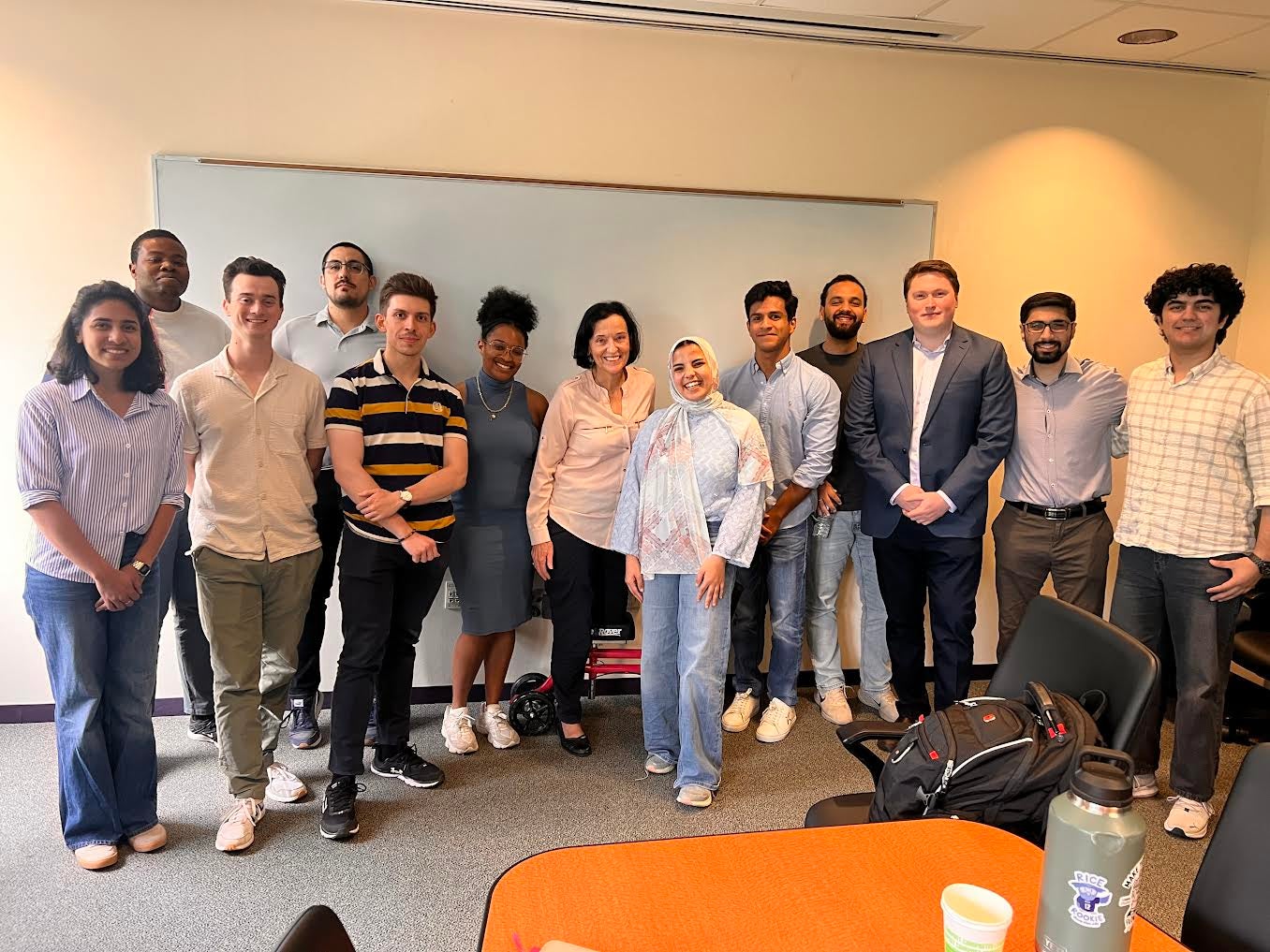
On April 16, 2026, the Department of Chemical and Biomolecular Engineering at Rice University welcomed Dr. Barbara Burger, former President of Chevron Technology Ventures, for the inaugural Conversations with Global Leaders fireside chat. The event brought together students and faculty for a candid discussion on leadership, energy innovation, and the evolving role of engineers in a rapidly changing world.
Moderated by Professor Haotian Wang and graduate student Chase Sellers, the conversation offered a rare opportunity for students to hear directly from a leader whose career has spanned research, global operations, and venture investing. Burger reflected on her path from earning a Ph.D. in chemistry at Caltech to leading innovation efforts at Chevron, emphasizing that her career was shaped less by a fixed plan and more by a willingness to learn and adapt. As she described it, “I got a degree in learning. I could go into an area that I didn’t know very well, and I could learn what was important, frame the problems, and figure out what experiments I needed to do.”
That mindset carried her from the lab into manufacturing, business leadership, and eventually venture capital, where she focused on identifying and scaling new technologies. Her experience across these domains provided a foundation for one of the central themes of the discussion: the complexity of today’s energy systems and the challenges of transitioning them. Rather than viewing the energy transition as a simple shift, Burger emphasized the need to balance multiple competing priorities. “You’ve got to make energy cheap enough for businesses and consumers, but you’ve got to create enough of a margin that investors are interested in backing it, and between those two is a very small area,” she noted.
For students working on emerging technologies, she emphasized that technical breakthroughs alone are not enough. Success depends on understanding how innovations fit into real-world systems and markets. Drawing from her industry experience, she explained that organizations are often hesitant to adopt new solutions unless the value is clear: “If the cost of change is higher than the value of the change, I don’t want to do that. Being able to really understand the problem is critical.” This perspective resonated with many in the audience, particularly those interested in translating research into practical applications.
The discussion also explored entrepreneurship and commercialization, areas of growing interest among students. Burger described commercialization as the process of turning technical knowledge into viable products and businesses, emphasizing the importance of identifying customer needs early. “Take technology and turn it into something that can be used in real-world operations—you have to find customers who are willing to pay more for it than it costs to produce,” she said. Her insights into venture capital and startup development helped clarify the path from lab-scale innovation to market impact.
Throughout the conversation, Burger returned to the importance of flexibility in career development. She encouraged students to remain open to new opportunities and to view their careers as evolving journeys rather than fixed trajectories. “You don’t have to do just one thing in your career, so don’t try to make the thirty-five-year decision now; you can try different things,” she advised, reinforcing the idea that diverse experiences can lead to more impactful and fulfilling work.
The event marked the launch of a new departmental speaker series designed to connect students with leaders across academia and industry. By sharing her experiences and perspectives, Burger offered attendees both practical guidance and a broader understanding of the challenges shaping the future of energy and engineering. Her message was clear: success in today’s landscape requires not only technical expertise, but also curiosity, adaptability, and a deep understanding of how innovation translates into real-world impact