
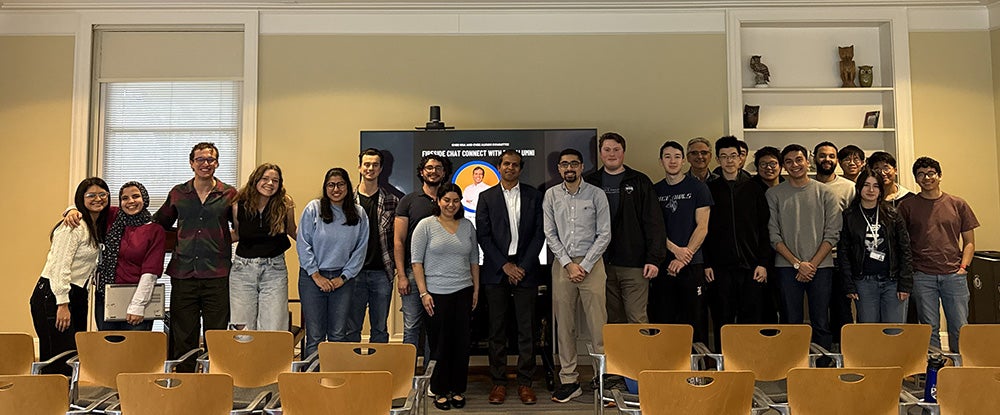
Graduate students and postdocs in Rice University’s Department of Chemical and Biomolecular Engineering (CHBE) gathered at Huff House for a candid and wide-ranging fireside chat with Sumedh Warudkar ’13, Director of Marketing for Low Carbon Chemicals & Products at Shell. Hosted by the ChBE Graduate Student Association in collaboration with the ChBE Alumni Committee, the conversation offered students an inside look at how a PhD can translate into a dynamic, non-linear career in industry.
Warudkar reflected on his time as a graduate student at Rice, where he worked under Professors George Hirasaki and Michael Wong. While both advisors were deeply rooted in energy and catalysis research, Warudkar described himself as an “odd duck,” pursuing carbon capture and gas separation research at a time when those topics were still emerging. Like many students, his graduate experience was marked by both setbacks and breakthroughs, but he emphasized that the real value of the PhD lay in learning how to think through complex problems. “We do PhDs to develop the ability to understand what’s actually driving the system,” he said, noting that once you begin thinking in terms of underlying physics and chemistry, “everything actually starts to become simpler.”
He likened this intellectual shift to a moment from The Matrix, when the protagonist begins to truly see how the world works beneath the surface. That way of thinking, Warudkar explained, extends far beyond the lab. Whether negotiating a business deal, shaping a strategy, or engaging with colleagues, the same analytical mindset applies. “If I understand what the human on the other side is motivated by,” he said, “I can create something that actually delivers value, rather than just presenting something empty.”
Equally influential, Warudkar noted, were the lessons he learned outside the classroom. During his time at Rice, he became deeply involved in student organizations, including the Graduate Student Association, where he developed leadership and communication skills that later proved essential in industry. “What differentiates you sooner than later is your ability to stand up confidently and engage with people,” he told students. “At the end of the day, you’re interacting with humans—you might be selling something, you might be buying something, but you’re always working with people.”
After earning his PhD, Warudkar joined Shell in a technical role that combined research with engineering support for refineries and chemical plants. Encouraged by mentors to broaden his experience, he deliberately sought roles that pushed him beyond traditional chemical engineering pathways. Over the next decade, his career spanned refinery economics, supply chain management, trading, and business development—each role building on skills developed in the previous one. While the path may appear non-linear, Warudkar emphasized that it was anything but random. “If you look at each role I’ve been in,” he explained, “it’s directly linked to the capabilities I built in the role before—and there’s always enough unknown to keep things interesting.”
Much of the discussion centered on energy transition and the realities of decarbonization. Warudkar stressed that while technological innovation is critical, progress depends just as heavily on policy, economics, supply chains, and consumer behavior. Technologies that integrate with existing infrastructure—such as carbon capture, biofuels, and low-carbon chemicals—are more likely to scale than solutions that rely solely on idealism. “If there’s no conviction that the cost curve comes down and becomes competitive,” he noted, “you’re going to struggle to move beyond a niche solution.”
When asked how engineers can influence policy, Warudkar offered a pragmatic perspective shaped by his industry experience. Policies tend to endure, he explained, when they align with economic realities and create shared incentives across industries. In those cases, companies and stakeholders actively advocate for regulatory certainty, increasing the likelihood of long-term impact.
Warudkar also shared advice for students considering careers in industry, encouraging them not to expect linear paths in a rapidly changing world. He urged students to invest early in transferable skills—communication, curiosity, adaptability—and to reflect on what truly motivates them. “If you assume you’re going to have a linear career, you might have some regrets,” he said. “Figure out what drives you, even if it’s just baby steps. That way, when things get uncertain, you still have a direction you’re traveling toward.”
The fireside chat left students with a clear message: a PhD is not just preparation for one job, but a foundation for lifelong learning, leadership, and impact—inside and far beyond the lab.