
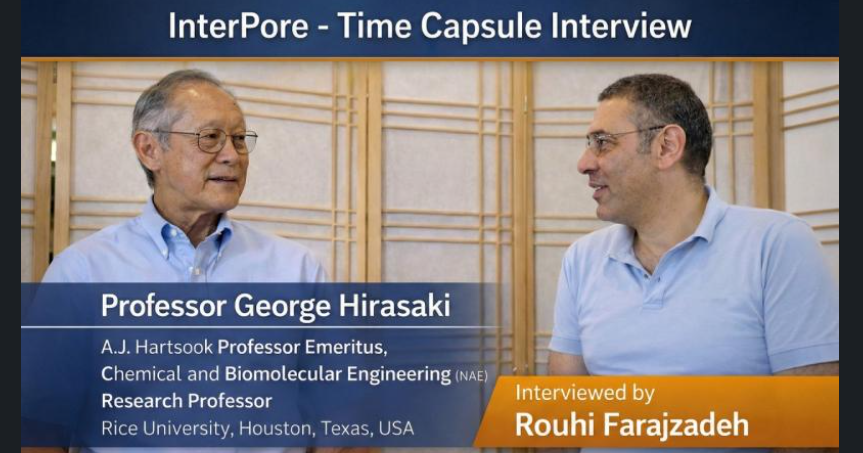
For George Hirasaki, Rice University has been much more than a place to study, teach and conduct research. It has been a constant throughout a remarkable career spanning academia and industry, and a community he continues to invest in for future generations.
Hirasaki, the A.J. Hartsook Professor Emeritus and research professor in Rice University’s Department of Chemical and Biomolecular Engineering, recently sat down with adjunct faculty member Rouhollah Farajzadeh for a conversation reflecting on his life and career.
Hirasaki’s connection to Rice dates back to his years as a doctoral student. His graduate research included work with the Rice-Baylor Artificial Heart Program, an ambitious collaboration that brought engineers and medical researchers together to tackle complex cardiovascular challenges. The experience helped establish an interdisciplinary approach to problem-solving that would follow him throughout his career.
After earning his Ph.D., Hirasaki embarked on a 26-year career with Shell Development and Shell Oil Company before ultimately returning to Rice full time in 1993. His research has explored fluid transport through porous media across scales, with contributions spanning enhanced oil recovery, nuclear magnetic resonance and the fundamental science governing how fluids interact with rock and other porous materials.
His accomplishments have earned recognition across the engineering profession, including election to the National Academy of Engineering. Yet Hirasaki’s impact at Rice extends well beyond his research.
Throughout his decades-long relationship with the university, he has remained deeply committed to educating and mentoring graduate students. Even after becoming professor emeritus, Hirasaki continued conducting research, teaching and collaborating with students and faculty, passing along not only technical knowledge but also the curiosity and hands-on approach that have defined his own career.
That commitment to the next generation is also reflected in his philanthropy. Hirasaki and his wife, Darlene, have supported Rice and its graduate students with the goal of ensuring that future scholars have access to the same kinds of transformative educational and research opportunities that shaped his own life.
The conversation with Farajzadeh offers a personal look at a career that has connected industry and academia, theory and experimentation, and generations of Rice engineers.
For Hirasaki, it is a legacy that continues to grow — through the research he has advanced, the students he has mentored and the opportunities he has helped create for those who will follow.