
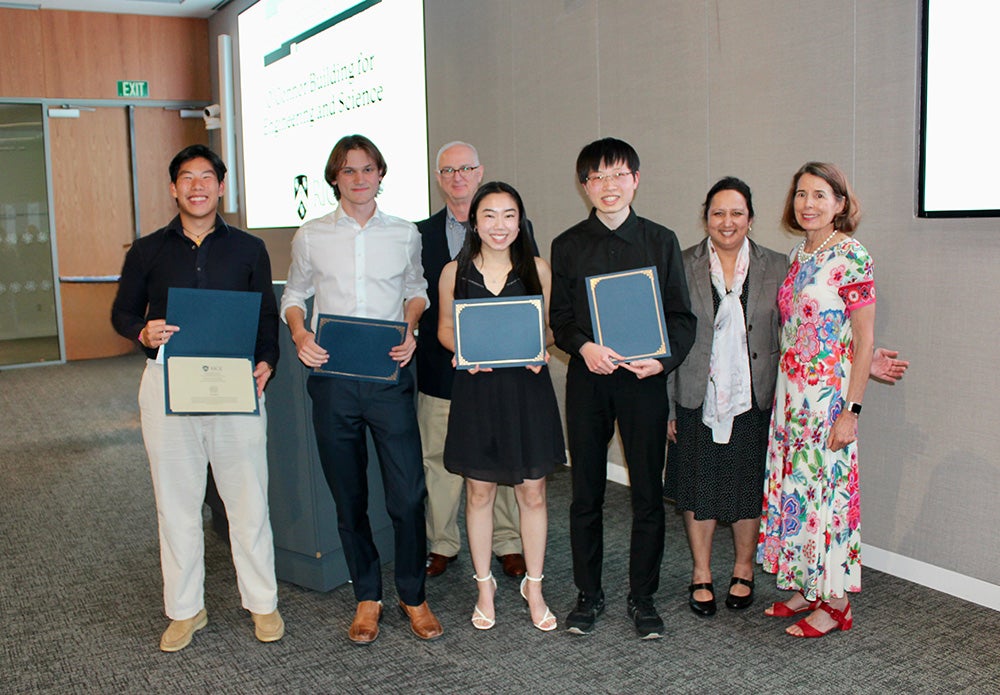
Students from the Rice University Department of Chemical and Biomolecular Engineering presented innovative, industry-driven solutions at the 2026 Akers Design Competition, the department’s annual capstone event highlighting senior design projects.
Held on April 23 in the Ralph S. O’Connor Building for Engineering and Science, the competition showcased the culmination of months of collaborative work, with student teams developing process designs that address complex, real-world challenges. The event brought together faculty, alumni and industry judges to evaluate each team’s technical rigor, creativity and practical impact.
This year’s top honor was awarded to PropylClean, whose team members—Gavin Mason, Dian Pan, Maggie Lim and Joshua He—developed a low-carbon propylene production process using propane dehydrogenation (PDH). Their design addresses the growing global supply gap for propylene while emphasizing sustainability and efficiency, positioning their solution at the intersection of industry demand and environmental responsibility.
The competition also featured two additional teams addressing major challenges in chemical engineering. ERROR 404 developed a plant design that integrates renewable energy with the Haber-Bosch process to produce green ammonia for downstream urea production, offering a lower-carbon path for fertilizer manufacturing. Meanwhile, Kind of Blue proposed a large-scale methanol plant designed for higher efficiency and reduced environmental impact that comes from carbon capture.
Together, the projects reflected a shared focus on sustainability, efficiency and innovation, which are key priorities shaping the future of the chemical and biomolecular engineering industry.
“The Akers Design Competition represents the culmination of our students’ undergraduate experience and their transition to professional careers or graduate school,” said Gerry McGlamery, Professor in the Practice, who is the instructor for the capstone design course. “What we see here are not just strong technical designs but thoughtful solutions that consider economic viability, environmental impact and real-world implementation.”
The Akers Design Competition remains a cornerstone of the undergraduate program, emphasizing not only technical excellence but also communication, teamwork and industry relevance. Students are tasked with developing complete process designs—from conceptualization through economic analysis—mirroring the expectations they will encounter in professional practice.
Throughout the event, teams presented detailed process flows, safety considerations and financial models, followed by a rigorous question-and-answer session with industry judges. These exchanges challenged students to defend their decisions and refine their thinking, offering valuable insight into the complexities of engineering in practice.
As the event concluded, one theme stood out: Rice students are prepared to tackle the pressing challenges facing the chemical industry, bringing forward solutions that are both innovative and grounded in real-world impact