
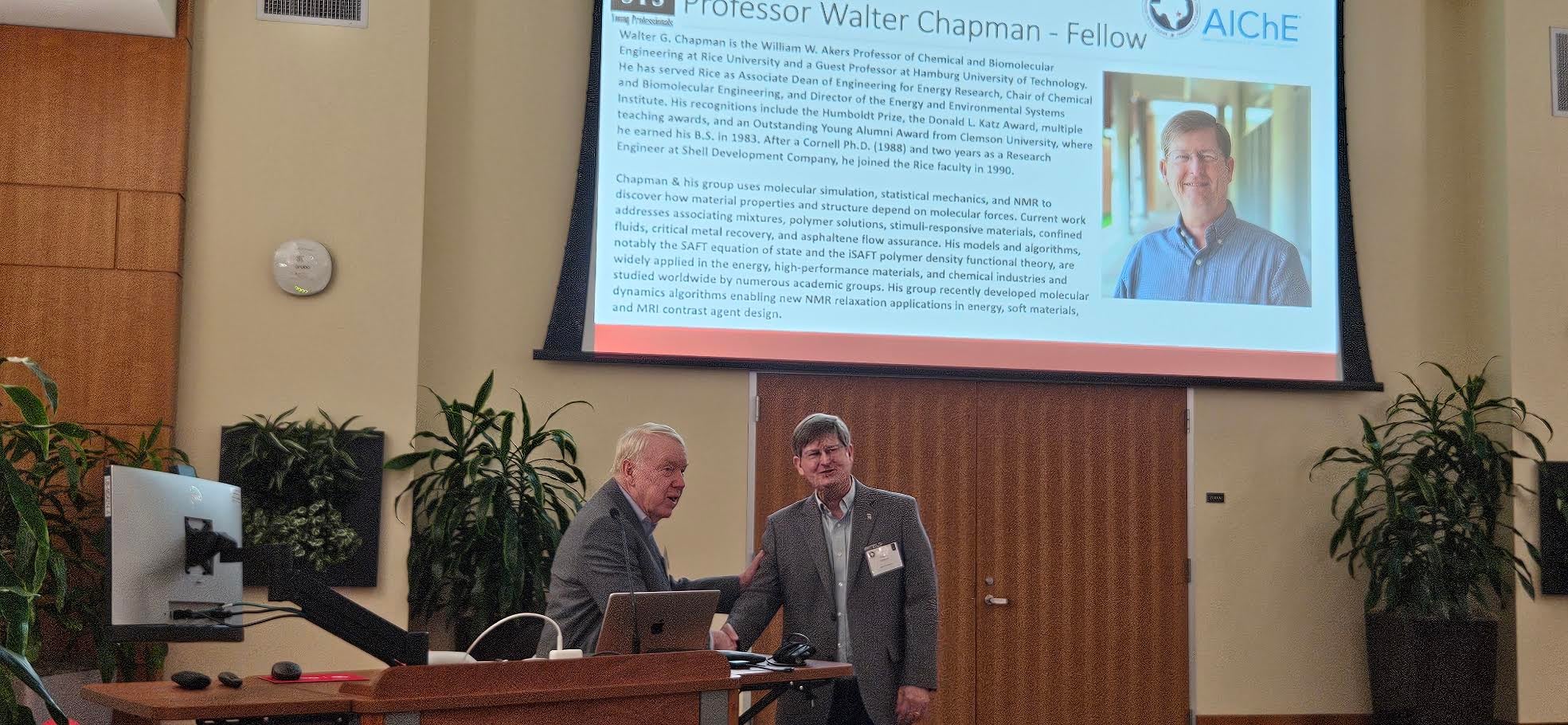
Walter Chapman, the William W. Akers Professor of Chemical and Biomolecular Engineering at Rice University, has been elected a Fellow of the American Institute of Chemical Engineers (AIChE), the organization’s highest grade of membership.
The distinction recognizes Chapman’s professional achievements and contributions to chemical engineering throughout a career that has spanned more than three decades at Rice. Election as an AIChE Fellow reflects the high esteem in which recipients are held by their colleagues and peers.
For Chapman, the recognition is also a reflection of the students and researchers who have contributed to that work throughout his career.
“This honor reflects upon the accomplishments and impact across industry and academia of my more than 50 graduate students and other collaborators,” Chapman said.
Chapman joined the Rice faculty in 1990 after earning his Ph.D. in chemical engineering from Cornell University in 1988 and spending two years as a research engineer at Shell Development Company. He has since held numerous leadership positions at Rice, including chair of the Department of Chemical and Biomolecular Engineering, associate dean of engineering for energy research and director of the Energy and Environmental Systems Institute. He is also a guest professor at Hamburg University of Technology in Germany.
Throughout his career, Chapman’s research has focused on using molecular simulation, statistical mechanics and, more recently, nuclear magnetic resonance (NMR) relaxation to understand how the properties and structures of materials emerge from molecular interactions. His work has applications across energy, advanced materials and chemical industries.
Among his most significant contributions is his role in developing and extending the Statistical Associating Fluid Theory (SAFT) equation of state and developing molecular density functional theory (iSAFT). These property models have been adopted by major energy, chemical and process simulation companies as well as dozens of academic groups. Chapman has distributed SAFT algorithms and code to more than 30 academic and industrial research groups and his iSAFT free energy functionals are a primary model in Sandia National Lab’s density functional theory package for nanostructured fluids in materials and biology called Tramonto.
His research has led to advances in predicting self-assembly of polymer and nanoparticle systems, predicting asphaltene precipitation and deposition in crude oil, measuring water content in natural gas under extreme conditions, and developing molecular simulation techniques for understanding NMR relaxation behavior. The latter has applications ranging from energy research to the interpretation of MRI contrast agents in medicine.
While Chapman is proud of the reach of that research, he points to the success of his students as an even more meaningful measure of his career.
“I am proud that our research has had such a broad impact across industry and academia, but the greatest product of academia is our students — both undergraduate and graduate — and I am most proud to have contributed to the success they have enjoyed,” Chapman said.
Most recently, Chapman received Rice’s Presidential Mentoring Award in 2025. His previous honors include the George R. Brown Award for Superior Teaching, the Nicolas Salgo Distinguished Teaching Award, the Graduate Student Association Faculty Teaching and Mentoring Award and the Outstanding Doctoral Thesis Adviser Award from Rice’s engineering school.
His broader professional honors include the Alexander von Humboldt Foundation’s Humboldt Prize, the Donald Katz Award from the Gas Processors Association and Clemson University’s Outstanding Young Alumni Award. His research has also repeatedly been recognized by the South Texas Section of AIChE with Best Applied Paper and Best Fundamental Paper awards.
“Walter has been an integral part of Rice Chemical and Biomolecular Engineering for more than three decades, and his influence can be seen not only in his important scientific contributions, but also in the many students and colleagues he has supported and mentored along the way,” said Lisa Biswal, chair of the Department of Chemical and Biomolecular Engineering. “He embodies the combination of scholarship, teaching, mentorship and service that we value so highly at Rice, and I am delighted to see AIChE recognize his remarkable contributions to our profession.”
As he looks ahead, Chapman sees chemical engineering — and the students preparing to enter the field — playing an increasingly important role in addressing challenges that span disciplines and industries.
“I am excited about the future of chemical engineering and graduates from our department at Rice University,” Chapman said. “Chemical engineers, true molecular engineers, are key to solving the world’s great challenges related to energy, environment, materials and health.”